Why Markets Move on Expectations, Not Reality ?
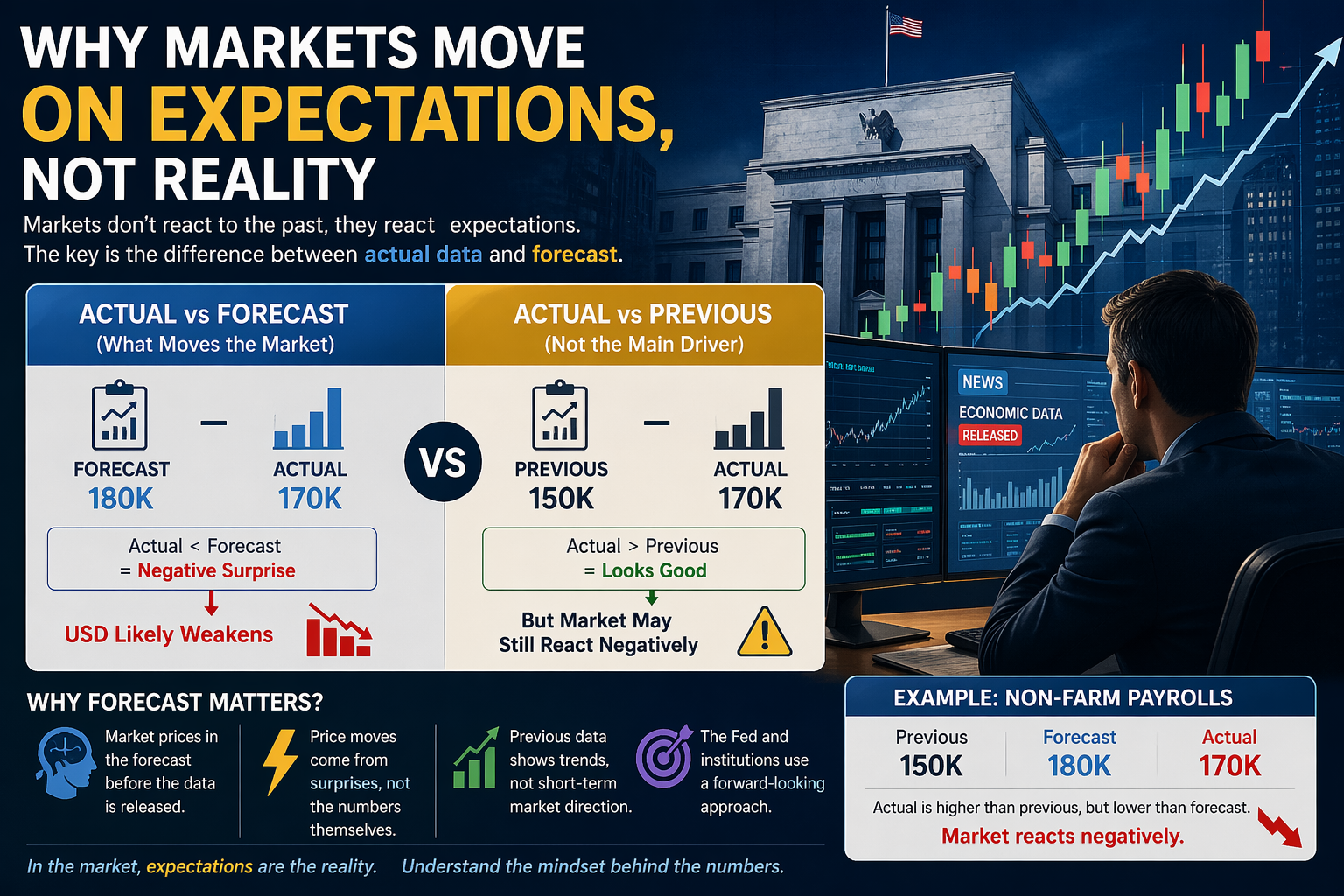
Global financial markets do not move based on the past, but on expectations. This is a key concept in understanding how markets react to economic data releases, particularly from the United States. Many beginner traders still make the mistake of comparing actual data with previous figures, even though the most important driver of price movement is the difference between actual results and market forecasts.
Before any economic data is released, major institutions such as investment banks and hedge funds have already formed projections known as forecasts. These figures are not merely predictions—they represent the market consensus and are often already priced into the market. In other words, markets frequently “anticipate” the outcome even before the official data is announced.
When the actual data is released, markets no longer react to the number itself, but rather to whether it meets, exceeds, or falls short of expectations. If the data matches the forecast, market reactions tend to be limited. However, when there is a significant deviation—either positive or negative—market volatility typically increases sharply. This phenomenon is known as an economic surprise, which serves as the primary catalyst for price movements.
On the other hand, previous data serves mainly as a trend indicator rather than a short-term market driver. It is used by analysts to build forecasts and to understand the historical direction of the economy. However, in news-based trading, market participants focus more on what deviates from expectations rather than whether current conditions are better than in the past.
For example, in the Non-Farm Payroll report, if the actual figure is higher than the previous data but still below the forecast, the market may react negatively. This highlights how expectations play a far more dominant role than historical comparisons.
This approach is also aligned with how the Federal Reserve conducts monetary policy. The central bank is known for its forward-looking approach, focusing on future projections and risks rather than relying solely on historical data. As a result, market expectations become a crucial factor in determining both policy direction and financial market movements.
By understanding that markets move based on expectations, traders and investors can avoid common misinterpretations. The comparison between actual data and forecasts is not just about numbers—it reflects the underlying market psychology that drives global price movements.
Source : Newsmaker.id