BOJ to Stand Pat as Ishiba’s Exit Adds to Clouds Over Rate Path
The Bank of Japan will likely leave its benchmark interest rate untouched this week after Prime Minister Shigeru Ishiba’s recent resignation announcement added to the list of uncertainties to consider.
All 50 economists surveyed by Bloomberg forecast that policymakers will keep the rate at 0.5% on Friday, at the end of their two-day gathering. BOJ officials are still assessing the economic impact of US tariffs both at home and abroad, people familiar with the matter told Bloomberg earlier this month.
That leaves BOJ watchers on the hunt for any signals that authorities might raise the rate in October — when more than a third expect action, or whether Governor Kazuo Ueda will essentially rule out that possibility.
The central bank is unlikely to talk about the implications of Ishiba stepping down as it seeks to underscore its independence from the government. Still, the impact from politics will probably be part of the board’s thinking, as will this week’s Federal Reserve rate decision. An expected US rate cut and an outlook flagging further reductions could give the yen a boost against the dollar.
Even with domestic political instability, BOJ officials see the possibility of raising the rate again by the end of this year as economic conditions have developed in line with expectations, according to the people familiar with the matter.
Since the last meeting at the end of July, tariff talks with the US have concluded with an executive order lowering car duties to 15%, while economic data have been relatively robust. A revised GDP report came in stronger than expected this month, offering another factor supporting the possibility of a near-term rate increase. With a key inflation gauge also staying at or above the BOJ’s 2% target for more than three years, speculation of a move has been persistent, though the timing remains open to debate.
“We continue to expect a rate hike to 0.75% in October as underlying inflation is rising steadily,” said Jin Kenzaki, chief Japan economist at Societe Generale.
At the same time, uncertainties remain following Ishiba’s announcement last week that he’ll quit. Analysts are conducting intense guessing games over who could succeed Ishiba, and the policy implications. The ruling Liberal Democratic Party coalition lacks a majority in both houses of parliament, creating the slight possibility that the new LDP leader voted in on Oct. 4 may fail to gain enough support in parliament to become prime minister.
BNP Paribas and Barclays are among those who have pushed back their rate call from October, citing political uncertainty. Some pundits see the next BOJ hike being delayed if top contender Sanae Takaichi heads the LDP, given her strong warnings against premature rate increases in the run-up to last year’s party leadership race.
“My base case is for an October hike but uncertainties over the timing of the hike have intensified with Ishiba’s departure,” said Taro Kimura, an economist at Bloomberg Economics.
Maintaining close coordination with the government is important for the BOJ given its history of clashes with past administrations during the normalization phases undertaken in the 2000s. That period sowed doubts among lawmakers over the BOJ’s commitment to support the economy. Those doubts were erased after the BOJ launched a massive monetary easing program in 2013.
BOJ officials are also closely monitoring the US economy including whether it can achieve a soft landing amid growing concerns after recent employment data looked anemic, people familiar with the matter said earlier this month.
A key concern is corporate profits and the extent to which employers can maintain wage growth momentum. The US tariffs are already creating risks, as the nation’s manufacturers recorded an 11.5% decline in pretax profit in the April-June period. Makers of transport equipment saw a 29.7% decline as carmakers cut prices in the US to preserve market share.
If the world’s biggest economy slows more than the BOJ currently expects, Japanese corporate profits would come under further pressure, crimping wage growth prospects and breaking an emerging virtuous economic cycle that’s crucial to Ueda’s hopes for sustainable inflation.
The pace of the Fed’s rate cuts is critical for the yen. A quick appreciation by Japan’s currency might exacerbate the shrinkage of Japanese businesses’ profit margins. On the other hand, the bank wouldn’t want the yen to weaken too much either, as that would fuel inflationary pressure that might compel the BOJ to implement rapid hikes.
US Treasury Secretary Scott Bessent and Japanese Finance Minister Katsunobu Kato reaffirmed their commitment last week not to target currencies for competitive advantage. Some analysts took this as a message from the US that the yen’s weakness should be corrected via BOJ rate hikes instead of currency intervention.
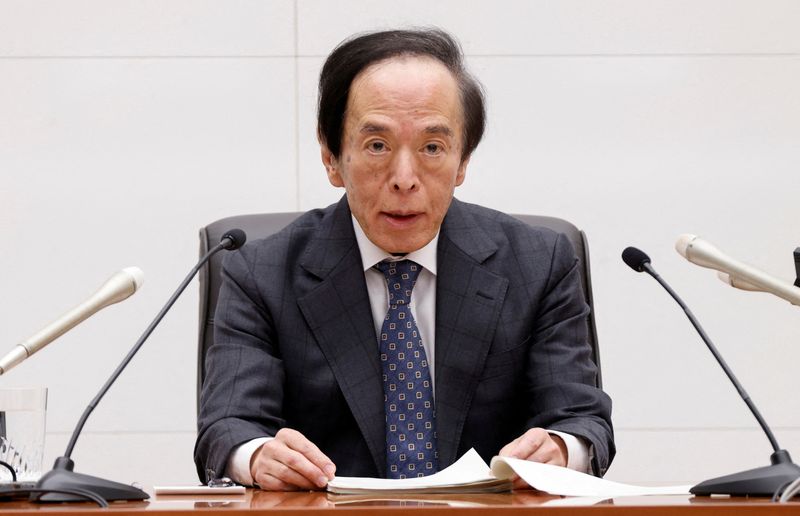
With little change expected in the BOJ’s policy statement this week, Ueda’s post-meeting press conference is likely to be Friday’s highlight for BOJ watchers.
“It’s very hard for Ueda to explain a stand-pat decision for September, as an overly dovish tone could weaken the yen,” said Nobuyasu Atago, chief economist at Rakuten Securities Economic Research Institute and a former BOJ official. “I’m watching how he is going to pull it off without sounding either too dovish or hawkish.”
More than half of BOJ watchers said there is a tendency for Ueda to sound dovish when the board keeps the rate on hold and hawkish when a rate hike takes place, according to a recent Bloomberg survey.
The governor will give a major speech on Oct. 3 to explain his view — an occasion where he could hint at whether there might be action at the Oct. 29-30 meeting.
“The BOJ’s next rate hike will be in December at the earliest, and January is the base case,” said Naka Matsuzawa, chief strategist at Nomura Securities. “It’s difficult for urgency for action to ramp up when the Fed’s rate cuts are priced in at every meeting this year.”
Source : Bloomberg