China Vows to Retaliate If Trump Makes Good on 100 Percent Tariff Threat
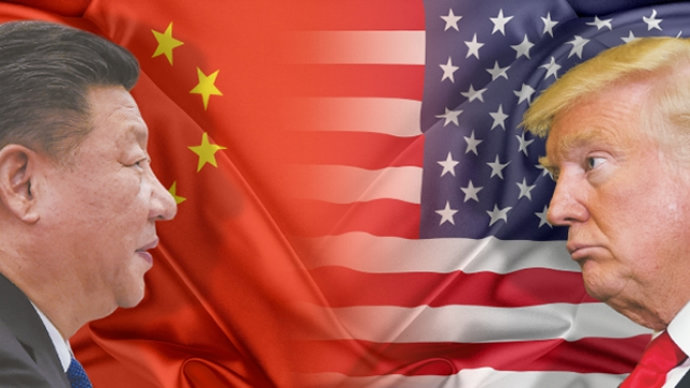
China has pledged to hit back if President Donald Trump carries out a threat to impose tariffs of 100 percent on all Chinese goods, as new data showed China's exports to the United States dropped sharply last month.
"Rather than reflecting on its own mistakes, the United States has threatened high tariffs," Lin Jian, spokesperson for the Foreign Ministry, said Monday. "If the United States insists on its own way, China will resolutely take retaliatory measures to safeguard its legitimate rights and interests."
The customs agency in Beijing said Monday that exports to the U.S. for September fell by 27 percent year-on-year to stand at $34 billion, although that was still an improvement on August total of $32 billion.
But China's overall export numbers were stronger than analysts expected, growing 8 percent last month compared to the same period a year earlier, thanks in part to a surge in shipments to transshipment hubs such as Vietnam.
"Some countries have abused tariffs, attacked the multilateral trade system and disrupted the global trade order," Lu Daliang, spokesperson for China's customs agency, said when asked about U.S.-China trade tensions at a news briefing Monday.
The data came amid signs the trade conflict between the world's two biggest economies was reigniting.
Beijing last week suddenly expanded export restrictions on critical raw materials used to make computer chips and defense technologies, prompting Trump to threaten an additional 100 percent duty on Chinese goods.
"Willful threats of high tariffs are not the right way to get along with China," Beijing's Ministry of Commerce said in a statement Sunday.
The statement accused the United States of "introducing a string of restrictive measures targeting China" over the past month, even though the latest round of bilateral trade talks ended with an agreement that Trump and Chinese leader Xi Jinping would meet in South Korea later this month.
The U.S. was applying a "double standard" by denouncing Chinese attempts to protect its supply chains, even as the U.S. has expanded its own restrictions on the export of advanced semiconductors and the software and equipment needed to produce them, the Ministry of Commerce said.
China on Thursday significantly tightened export controls on rare earths and the products that they go into. The country accounts for about 90 percent of the global processing of these chemically unique metals that are essential to the manufacturing of everything from smartphones to fighter jets.
The new regulations require foreign entities anywhere in the world that make products containing even tiny amounts of these metals to apply for licenses from Beijing. China will also require approval for technology related to rare earth mining and smelting to be sold abroad.
In response, Trump on Friday said that the additional 100 percent duty would be imposed on Chinese goods on Nov. 1 or sooner, "depending on any further actions or changes taken by China." He also threatened to cancel a planned meeting with Chinese leader Xi Jinping at the Asia-Pacific Economic Cooperation forum in about two weeks.
Trump appeared to soften his tone on Sunday. "Don't worry about China, it will all be fine! Highly respected President Xi just had a bad moment. He doesn't want Depression for his country, and neither do I," he wrote on Truth Social.
While the latest flare-up could blow over by the time Xi and Trump meet, "there is clearly a risk that both sides may dig in their heels, expecting their opponent to fold first," said Julian Evans-Pritchard, an analyst at Capital Economics, an economic research firm based in London.
Rather than a limited deal that keeps most levies in place, Chinese trade negotiators have been pushing for a substantial reset in trade relations, including the complete removal of tariffs and export controls on advanced technologies.
Beijing "may have calculated that China can endure the impact of any new U.S. tariffs for longer than the U.S. is willing to put up with rare earth restrictions," Evans-Pritchard wrote in a note published Monday.
Source : Bloomberg.com